
This article clarifies the differences between fluoroplastics PTFE, FEP, PFA, and ETFE!
This article clarifies the differences between fluoroplastics PTFE, FEP, PFA, and ETFE!
——This article is translated from the original Polymer Detective Agency
Today, let's talk about a topic that many people find confusing: What is the relationship between PTFE, FEP, PFA, and ETFE? Are they all fluoroplastics? What are the differences in their properties and applications? Is there a big price difference? Is it difficult to process them
Many people call these materials interchangeably, or even directly say "it's all Teflon anyway." As a result, they often encounter problems when using them, either because the performance is excessive or the requirements are not met.
Today, we will clarify them all at once:
1. Why are there so many types of "PTFE family" materials?
2. What exactly is the difference in molecular structure?
3. What are the differences in performance?
4. How to choose application scenarios?
5. What about the price and processing difficulty?
01 Let's start with why there is modification
When it comes to the granddaddy of fluoroplastics, it has to be PTFE (polytetrafluoroethylene). Born in 1938, it has become a legend in the chemical, mechanical, electronic, and other industries, thanks to its three key features: high temperature resistance, corrosion resistance, and low friction coefficient.
However, it also has its "fatal flaw":
· Poor processability: Due to its high melting point and high melt viscosity, it cannot be molded using ordinary thermoplastic methods and can only be processed like metal powder through pressing and sintering;
· Weak mechanical properties: especially in terms of creep resistance and wear resistance (note: a low friction coefficient does not necessarily mean the material is wear-resistant), pure PTFE tends to "creep" under load;
· Transparency is almost non-existent: only white or milky white products can be made.
Therefore, people from chemical plants, cable factories, and medical device factories began to ponder whether it was possible to make it easier to process and have a more balanced performance while retaining its heat resistance and corrosion resistance. Thus, FEP, PFA, ETFE, and other "modified/homologous" materials of PTFE were developed.
02 Molecular structure differences
The performance of fluoroplastics ultimately stems from their molecular structure, especially the presence of fluorine atoms. Fluorine atoms have a small radius and strong polarity, and the C–F bond formed with carbon is the strongest among known organic bonds (with a bond energy of up to 485 kJ/mol), making fluoroplastics almost impervious to chemical attack.
Let me explain their structural differences to you in plain English:
· PTFE (Polytetrafluoroethylene)
· Basic structure–[CF₂–CF₂]–
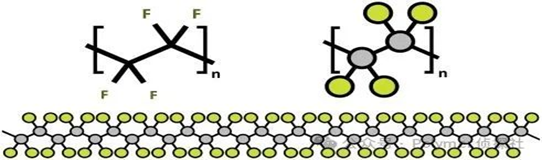
· Structural characteristics: The carbon chain is completely encapsulated by fluorine, forming a straight chain structure with high crystallinity. It is like a perfluorinated "armor", impermeable and indestructible, but it is too hard and slippery to process;
· FEP (Fluorinated Ethylene Propylene Copolymer)
· Basic structure:–[CF₂–CF₂]– with a small amount of –[CF₂–CF(–CF₃)]
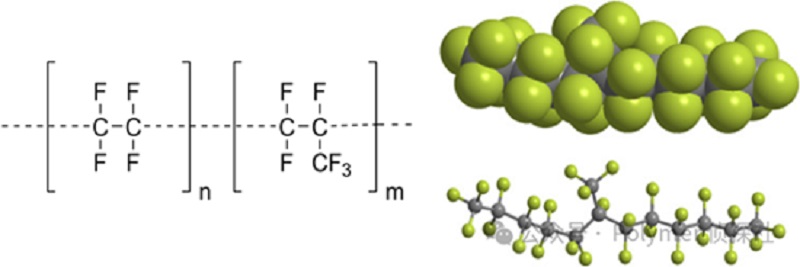
· Structural characteristics: Introducing a small amount of hexafluoropropylene (HFP) units into the PTFE backbone disrupts its regularity - akin to puncturing small holes in armor (by introducing HFP), making the molecular chain less structured, thus enabling melt processing;
· PFA(perfluoroalkoxyethylene copolymer)
·
· Basic structure:–[CF₂–CF₂]– with a small amount of –[CF₂–CF(–OR_F)]
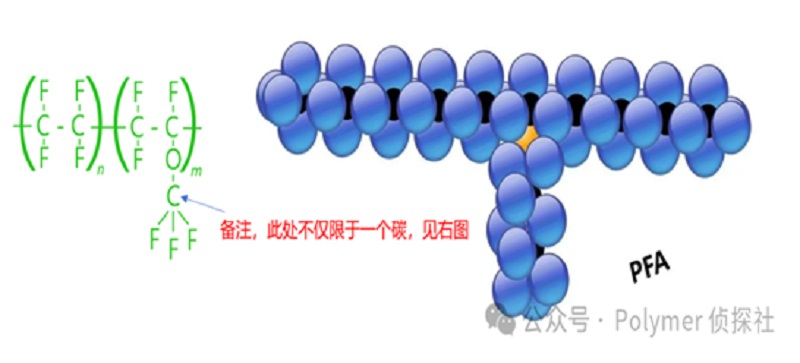
· Structural characteristics: By introducing perfluoroalkyl etheroxy side chains into the PTFE main chain, the melt flowability is improved. Not only are holes created, but also "flowability pendants" (perfluoroalkyl etheroxy groups) are attached, resulting in better processing performance and higher temperature resistance compared to FEP;
· ETFE (ethylene-tetrafluoroethylene copolymer)
· Basic structure: –[CH₂–CH₂]– and –[CF₂–CF₂]–
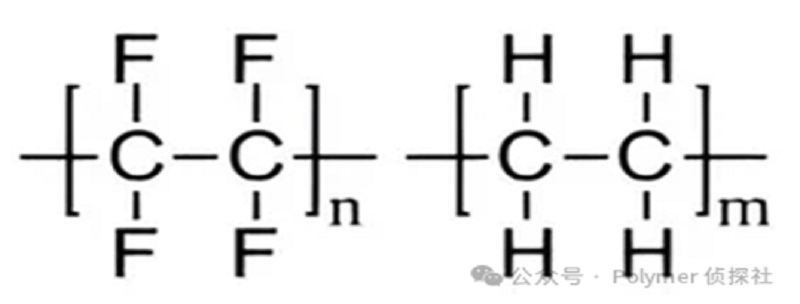
· With a lower fluorine content than PTFE, it boasts better toughness and is easier to process. By alternating half of the "fluorine armor" with lightweight (ethylene), some chemical resistance is sacrificed in exchange for higher strength and toughness.
05 Price difference
Market average price (for reference only, average market price of fluoroplastic in 2024, yuan/kg):
· PTFE:60~80
· FEP:120~160
· PFA: 200~300 (semiconductor grade is more expensive)
· ETFE:90~120
Note: The above is the bulk purchasing price (≥1 ton) in East China, subject to ±15% fluctuation due to crude oil/fluorspar price fluctuations.
PFA is expensive due to its complex synthesis process and high application threshold; FEP is more expensive than ETFE because of the high cost of fluorine monomers and low production volume.
06 Differences in processing difficulty
PTFE
Processing method: Molding and sintering / paste extrusion and expansion
Core challenges:
· Ultra-high melt viscosity (10¹¹~10¹² Pa·s) → unable to melt and flow
· Large sintering shrinkage rate (3% to 5%) → Difficult to control dimensional accuracy (requires compensatory design)
· Thermal cracking risk: Release of highly toxic perfluoroisobutylene (PFIB) at temperatures >400℃
FEP
Processing method: Extrusion/Injection molding/Blow molding (Processing temperature: 300~330℃)
Core challenges:
· Narrow temperature window (±10℃) → Poor fluidity at low temperatures, decomposition at high temperatures
· HF corrosion: decomposition at >350℃ produces hydrogen fluoride → corrodes equipment (requires Hastelloy alloy screws)
Low melt strength → sagging during extrusion, uneven film thickness
PFA
Processing method: Extrusion/Injection molding/Blow molding (Processing temperature 340~380℃)
Core challenges:
Low melt strength → Parison sagging during blow molding (requiring radial heating compensation of the die head)
· Ultra-pure requirements: For semiconductor-grade applications, platinum flow channels are necessary to prevent metal ion contamination
· Sensitive to surface defects: impurities > 0.1μm → film pinholes (melt filter required)
ETFE
Processing method: extrusion/injection molding/thermoforming (processing temperature 240~270℃)
Core challenges:
· Fast crystallization speed → Uneven cooling may lead to warping (mold temperature needs to be controlled within ±2℃)
· Water absorption rate of 0.1% → Pre-drying is necessary (80℃/4h, moisture content ≤0.02%)
· Electrostatic accumulation: surface resistance > 10¹⁶Ω → Ion wind is required for static elimination during cutting
07 Material Selection Tips
A simple approach:
· Ultimate corrosion resistance + high temperature: choose PTFE or PFA;
· Transparent + corrosion-resistant + moderate to high temperature: choose FEP or PFA;
· Strength + Weather resistance + Medium temperature: choose ETFE;
· Limited budget → Consider ETFE first, then FEP, and finally PFA
