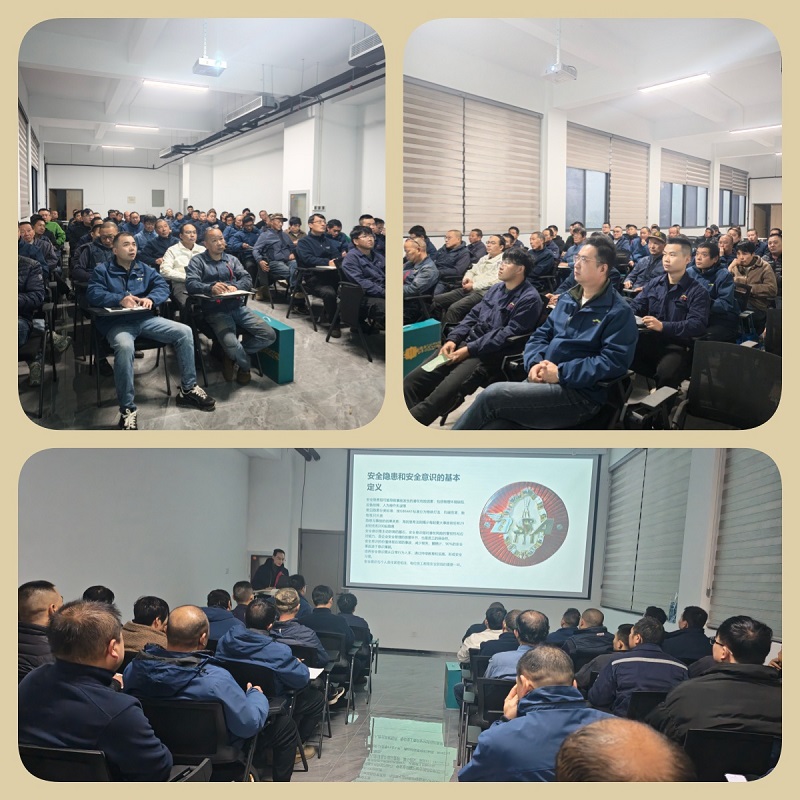
To further enhance the awareness of potential safety hazards among all employees, Shanjian Anti-corrosion recently organized a special training activity on potential safety hazards identification and safety awareness improvement for all employees. The theme of this training is "Establishing Awareness of Potential Safety Hazards Identification and Practical Operation of Hazard Case Investigation", covering all departments and front-line production employees of the company. The aim is to strengthen the defense line of hazard investigation through theoretical explanations, practical drills, and case analysis.
1. Basic understanding of safety awareness
1. Emphasize the basic definition of safety hazards and safety awareness, requiring all employees to cultivate safety awareness starting from daily behaviors, and through continuous education and practice, form safe habits;
2. Based on the typical risk characteristics of the anti-corrosion industry in Shanjian, we will focus on categorizing and explaining the risk characteristics of industrial and trade enterprises. For machinery manufacturing, equipment damage is the main concern; physical safety hazards include equipment malfunctions and environmental risks, etc;
3. Publicize and implement the new safety law to clarify the legal and regulatory requirements regarding the main responsibility of enterprises, and require the establishment of a dual prevention mechanism for safety risk classification control and hidden danger investigation and treatment.
II. Hazard identification method system
1. The safety checklist method lists the requirements of laws, regulations, standards, and enterprise systems in the form of a checklist. During hazard identification and inspection, items are checked one by one, with clear objectives, clear organization, simple operation, and easy recording;
2. The safety observation method does not rely solely on checklists, but focuses on observing "unsafe human behaviors" and "unsafe states of the environment/objects". It emphasizes non-punitive, communicative observation, which can identify dynamic risks not covered by checklists and promote the enhancement of employees' safety awareness;
3. Employee feedback collection method: Encourage employees to proactively report potential safety hazards, and regularly conduct safety forums to stimulate full participation in safety improvement efforts.
III. Analysis of typical hidden danger cases
1. Identification of mechanical injury hazards mainly includes: cases of missing protection at transmission parts, lessons learned from the failure of emergency stop devices, and the implementation of maintenance tagging systems;
2. Identification of electrical fire hazards mainly includes typical cases of line overload, failure of leakage protectors, and unauthorized operations in explosion-proof areas, etc;
3. Hazards in chemical management mainly include: risks of mixed storage of hazardous chemicals, improper emergency response to leaks, etc.
IV. Practical Drill for Hidden Danger Investigation
1. Conduct on-site simulation inspection training, set up hidden danger scenarios, and simulate common hidden danger points such as distribution boxes and processing equipment;
2. Standardize the rectification process, emphasizing the establishment of a hidden danger registration ledger, which details the description of the problem, the responsible person, and the rectification deadline, etc;
3. Develop a rectification plan, propose a principle for handling hidden dangers at different levels, design training for rectification measures, and propose methods for verifying the effectiveness of rectification.
V. Key points of long-term mechanism construction
1. System construction and implementation, emphasizing the establishment of a comprehensive hidden danger investigation system and clarifying the responsibilities of personnel at all levels; meanwhile, establishing an assessment mechanism;
2. The training system is continuously optimized, with specialized training provided for new employees, experienced employees, and management personnel based on their levels and categories. At the same time, innovative training methods and approaches should be adopted, and a training effectiveness evaluation mechanism should be established;
3. Cultural creation and atmosphere building: Propose to carry out a series of safety-themed activities, including knowledge contests, safety pacesetter selection, etc.; cultivate safe behavior habits.
Safety is not only a responsibility, but also a commitment. Shanjian Anti-corrosion will take this training as an opportunity to continuously implement the safety production policy of "safety first, prevention first, comprehensive management", ensuring the sustained and stable operation of the company.

Address: No.815, Chenggang Road, Nantong City;
Jiangsu Province (180m west of gas station)
Yuwan Middle Road, Tongzhou District;
Nantong City, Jiangsu Province
Postal Code:226351
Telephone:+86-513-85565205
Network promotion telephone:+86-513-55881890
Fax:+86-513-85565141
E-mail address:ntsmsb@163.com
Website:www.graphite-sj.com